Our Technology Portfolio

Twelve Ways We Stop
Your Facility from Losing Money.

Every DES solution targets a specific, quantifiable source of operational underperformance, from real-time process control and Digital Twin simulation to combustion optimization and continuous performance monitoring. Together, they form a complete technology platform for industrial facilities that refuse to accept the gap between what they produce and what they are capable of producing.

Complete Solution Portfolio

Targeted Technology. Measurable Impact. Sustained Results.

DES solutions are deployable on all modern distributed control and PLC systems or as PC-based applications interfacing via OPC, Modbus, and PROFINET. Every solution integrates with your existing infrastructure. The only thing that changes is performance.

01

Energy Management & Reporting System (EMRS)

The EMRS is the operational brain of DES technology, continuously optimizing fuel allocation, boiler loading, and steam distribution against an exhaustive set of process, safety, and environmental constraints, every second of every day. It doesn't suggest. It doesn't alert. It acts.

The result is a facility that always operates at the economic frontier of its constraints - capturing every opportunity, respecting every boundary, and reporting every barrier to improvement in language that drives action. Clients have reduced fossil fuel costs by over $500,000 per month and cut total production costs by 2.5%.

02

Real-Time Pricing Demand Response — OptiMaxx

Energy markets create and close economic opportunities in minutes. OptiMaxx is a suite of software modules embedded directly into your facility's existing control system — or deployable as a stand-alone application via OPC or Modbus — that continuously calculates your marginal cost to generate electricity internally, based on fuel costs, boiler efficiencies, turbine efficiencies, and condensing and venting costs. That internal cost is compared in real time against the current market price retrieved over the Internet, and OptiMaxx decides autonomously whether to buy, make, sell, or shed power.

Based on those calculated decisions, OptiMaxx automatically drives condensing steam turbine generators to their optimum operating point while observing all applicable constraints — emission limits, boiler limits, turbine and generator limits, and contractual limits. Where economical, it can choose to vent steam to make additional power with non-condensing generators, or include gas turbines in the overall electrical optimization. Unlike systems that take several minutes to calculate a move, OptiMaxx acts every second without exception.

A unique plain-language constraint messaging system informs operators and managers precisely what is preventing the system from doing better — specific messages such as “Can't increase boiler load because ID fan is at maximum.” Daily frequency distributions of constraint events are automatically compiled, creating a continuously updated, prioritized roadmap for equipment improvements that increases savings further over the life of the deployment.

OptiMaxx also supports traditional interval demand tie-line control, instantaneous MW purchase control, and smart load-shedding that prevents new demand peaks or curtails very expensive power purchases using prioritized load tables. Documented results include $50,000 in monthly electrical cost reductions at a single paper mill. Due to current fossil fuel costs, most OptiMaxx installations recover their full investment within months of deployment.

03

MultiMaxx — Predictive-Horizon Multi-Fuel Boiler Control

MultiMaxx is a breakthrough in boiler control technology that solves the central challenge of modern powerhouse operations: maintaining header pressure to a single setpoint across one or more boilers while continuously minimizing the cost of steam generation and observing multiple simultaneous constraints. Any number of boilers. Any number of fuels. Every second — without fatigue, without inconsistency, without the judgment lapses that even the best operators experience across a twelve-hour shift.

The core innovation is the predictive-horizon header pressure controller. Rather than reacting to instantaneous header pressure, MultiMaxx adjusts boiler loads to maintain a predicted pressure several minutes into the future — analogous to driving while looking down the road rather than just over the hood. This prevents boilers from over-responding to process upsets caused by response lags, eliminating the thermal stress and fuel waste that characterize conventional reactive control. MultiMaxx also takes advantage of header storage capacity — using the header volume as a steam flow balance indicator, eliminating the need for multiple steam flow measurements required by conventional feed-forward controls.

Consider a facility using bark and fossil fuel. Bark is essentially free but slow — ten-minute response time. Fossil fuel is expensive but fast — two-minute response time. MultiMaxx manages this trade-off continuously and autonomously: using fossil fuel precisely while waiting for bark-produced steam to respond, then returning fossil fuel to minimum as bark steam comes online. The result is tighter header pressure control at substantially lower cost than either fuel alone could achieve — with the specific economy-versus-performance balance determined by the facility owner, not by the shift operator on duty.

Constraint management is comprehensive and continuous. Minimum and maximum steaming limits, furnace draft, drum level and stability, fuel pressure and flow, damper positions, O2 percentage, opacity, particulate emissions — all monitored every second. As constraints are approached, fuel master adjustments are proportionally reduced to prevent violations. When one boiler is constrained, the remaining boilers automatically absorb more of the load. By observing real constraints rather than artificial comfort zones, MultiMaxx routinely unlocks additional steam capacity that facilities had assumed was unavailable.

A plain-language messaging system explains constraint encounters in real time — “Boiler 5 cannot increase hog steaming because ID Fan is maximized” — while daily constraint frequency reports identify and prioritize the process improvements that would increase savings further. MultiMaxx is deployable as modular algorithms residing directly in the regulatory control platform as an integral part of each boiler's combustion controls, providing extreme reliability and graceful fallback to individual boiler control in the event of a supervisory system failure.
04

Combustion Optimization

Every point of excess air leaving your stack represents fuel you paid for and didn't use. Every incomplete combustion event represents both a cost and a compliance risk. DES combustion control eliminates both, maintaining peak thermal efficiency, flame stability, and regulatory compliance simultaneously across biomass, natural gas, fuel oil, and waste-heat configurations.

The savings are not dramatic on any given minute. They are relentless across every hour of every day the system runs and they compound into numbers that change annual financial performance materially. Combustion optimization is often the highest-return, lowest-disruption entry point for facilities new to DES technology.

05

Variability Management

Process variability is the hidden tax that every industrial facility pays and almost none of them measure. It degrades product quality, accelerates equipment wear, forces conservative operating targets that leave capacity untapped, and introduces risk that management cannot quantify because it doesn't appear on any single report.

DES variability management solutions systematically eliminate it by deploying advanced process controls and operating philosophies that enable your facility to run closer to its true economic limits with the consistency and confidence that only autonomous control can provide. Less variability means better products, better margins, and less maintenance.

06

Coordinated Operations Services

When production objectives are stable and the primary source of underperformance is inconsistent operator technique, the solution is not more training. It is coordinated control. DES coordinated operations solutions provide single-knob production rate management that aligns related process units and eliminates the costly performance variability that individual operators inadvertently introduce.

This approach intentionally avoids the maintenance burden that chronically undermines traditional optimization schemes, creating a fundamentally more agile, reliable operation that performs consistently across every shift, every operator, and every set of conditions.

Single-Knob Control Unit Coordination Shift Consistency Learn More →
07

Opportunistic Optimization Control

Some opportunities to improve economic performance last minutes. Others last hours. Most facilities miss both, because identifying them requires continuous monitoring of dozens of variables, and acting on them requires immediate, confident decision-making that operators are rarely positioned to provide while managing the broader demands of their shift.

DES opportunistic optimization control provides the constant autonomous driving force that captures every one of these transient windows, moving your facility toward economic optimum the moment conditions allow, and sustaining that position until conditions change. It is the difference between a facility that reacts and a facility that leads.

Transient Capture Continuous Optimization Market Responsiveness Learn More →
08

Engineering Audits & Project Justification

The question every executive asks before approving a capital project is the same: what exactly will we get, and what happens if we don't get it? DES engineering audits answer both, with a level of specificity and methodology precision that most technology vendors cannot offer, because most technology vendors don't have two decades of field results to calibrate their models against.

Our audit identifies your specific optimization opportunities, quantifies them in documented financial terms, and provides the project business case your organization needs to move from interest to approval. We then hold ourselves accountable to those numbers after deployment, which is why we do the analysis rigorously in the first place.

09

Digital Twin — Process Simulation & Virtual Plant

Before a single valve is turned or a control loop is modified, DES Digital Twin technology lets you test every change in a high-fidelity virtual replica of your actual plant. New process logic, control reconfigurations, equipment modifications, all validated in a simulated environment where failure has no operational consequences and every result is a data point rather than a disruption.

Digital Twin simulators are among the lowest-capital, highest-return investments available to industrial operators. They eliminate the risk of unexpected shutdowns during commissioning, reduce the time to stable operation after modifications, and provide a permanent training environment that keeps operator capability current without touching live systems. Facilities that build complex process logic on top of a validated virtual model deploy faster, tune faster, and sustain better performance over time.

DES Digital Twin deployments integrate directly with our optimization platform, so the same model that trains your operators and validates your control logic also informs your real-time optimization engine. One investment. Multiple compounding returns.

Process Simulation Virtual Commissioning Operator Training Control Logic Validation Request a Demo →
10

Process Performance Engineering & Improvement

Most industrial facilities have optimization technology installed somewhere on site. Most of that technology is underperforming, not because the technology is wrong, but because instrumentation calibration has drifted, control loop tuning hasn't been revisited since commissioning, and the operating philosophy that made sense at installation no longer reflects current market conditions or equipment capability.

DES process performance engineering identifies exactly where your facility is leaking value, quantifies each gap in financial terms, and implements the specific combination of instrumentation improvements, tuning updates, and advanced control strategies required to close it. This is not a generic audit. It is a facility-specific analysis grounded in two decades of application data across the industrial sector.

Performance improvements are then sustained through ongoing monitoring protocols and defined escalation paths, so the gains delivered at go-live do not erode quietly over the following eighteen months as conditions evolve. Improved process performance is only valuable if it persists.

Control Loop Optimization Instrumentation Review Performance Baselining Sustained Improvement Learn More →
11

Biomass & Waste Fuel Combustion Control

Biomass and waste fuel boilers operate in a uniquely hostile optimization environment. Fuel quality varies continuously and is rarely measurable in real time. Heat release is delayed, non-linear, and difficult to predict from conventional sensor data alone. Environmental compliance windows are narrow, and the cost of transgressing them: downtime, penalties, and reputational damage - is asymmetric with the fuel savings at stake.

DES has developed a Heat Release Soft Sensor specifically for this environment, a technology that infers combustion quality from available process signals in real time, enabling responsive and stable fuel master control without requiring instrumentation that these boiler types cannot practically support. The result is tighter steam output, reduced fuel cost, lower maintenance frequency, and sustained compliance performance across the full operating range of the boiler.

This technology applies to biomass, municipal solid waste, chemical waste, and mixed-fuel configurations, anywhere that conventional combustion control approaches are made unreliable by fuel quality variability or measurement constraints.

12

Online Performance Monitoring & Remote Analysis

Optimization technology that isn't being monitored is optimization technology that is quietly degrading. Control loops drift. Equipment characteristics change. Operating conditions shift. Without systematic performance tracking, the benefits delivered at deployment erode and because the erosion is gradual, it rarely triggers any alarm until the gap between current performance and original performance has grown into a significant financial loss.

DES online performance monitoring provides continuous visibility into the health of your deployed control strategies, your regulatory loops, and your key performance indicators, through dashboards built around your specific process and calibrated to the performance levels that DES technology delivered at commissioning. Anomalies are identified early, root causes are diagnosed remotely, and interventions are scheduled before unplanned downtime becomes unavoidable.

This is the infrastructure that converts a one-time optimization deployment into a permanently high-performing operation and it is what separates facilities that sustain results from facilities that review their last audit and wonder where the gains went.

Real-Time Dashboards Remote Diagnostics Loop Health Tracking Proactive Maintenance Learn More →
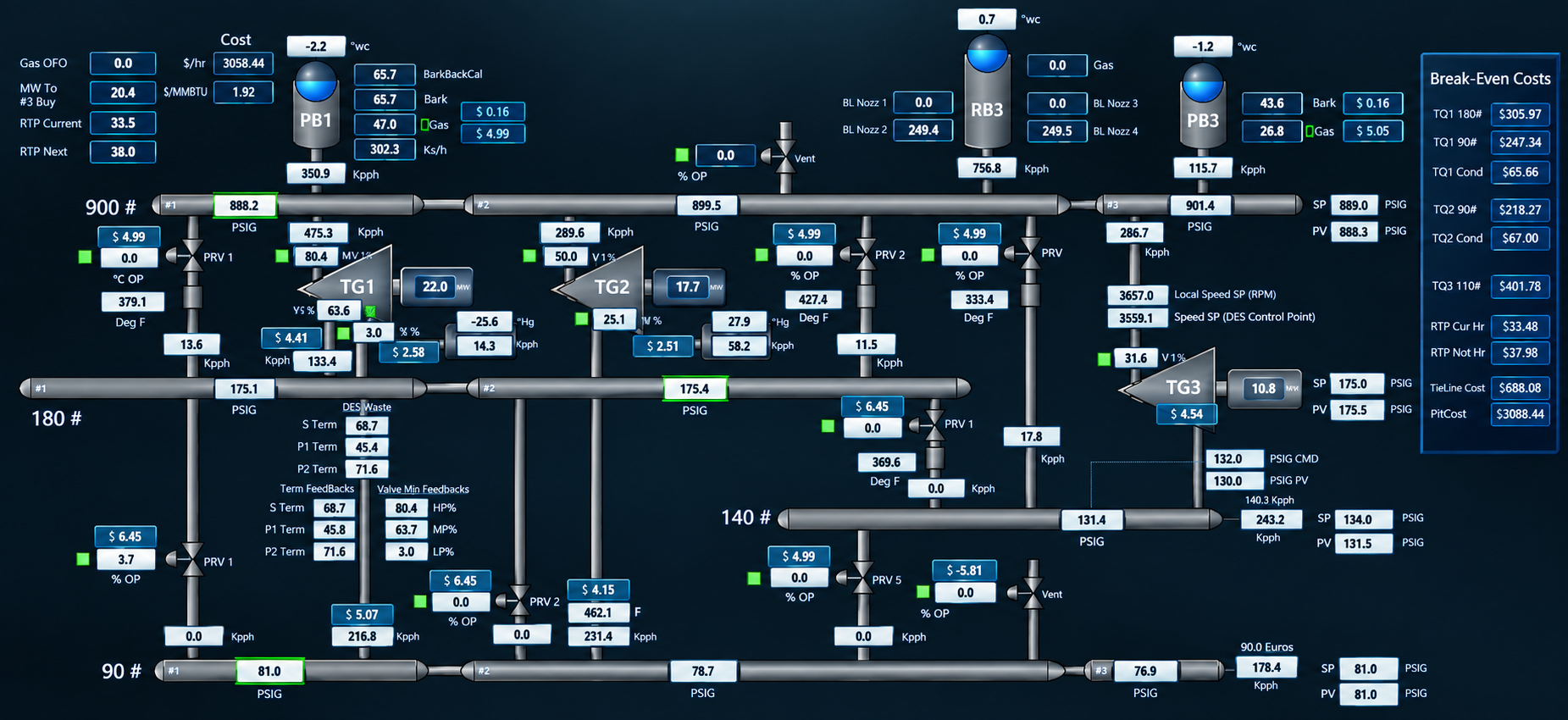
DES real-time process control and optimization dashboard

If You Can Imagine Your Process Running at True Optimum - That's a DES Deployment.

Changing configuration automatically in response to live market prices. Operating at the economic frontier of every constraint. Reporting barriers to improvement with enough specificity to act on. Running the way your designers always intended. Every second. Without exception. This is what DES technology delivers and what clients say they cannot imagine operating without.

Begin Your Evaluation →
Validation from the Field

Straight Talk from People Who Run These Plants.

"

Pulp Mill & Utilities Superintendent - Catalyst Paper Corp, Elk Falls Division

"Any facility that fails to embrace DES remarkable technology would be remiss in their operational reliability and energy reduction objectives." This is not enthusiasm. It is a professional assessment from someone who has seen both sides of the decision.

"

Senior Industry Leader - North America

"In the very near future in North America there will be two kinds of mills: those that embrace DES technology and those that are no longer in business." The competitive implications of autonomous optimization are not incremental. They are structural.

"

Process Control Manager - Alberta, Canada

"DES is truly the leader not only in Closed Loop energy management but Process Optimization as well. In addition to their outstanding control solutions, DES truly understands the process and how to apply the technology. The benefit exceeds anything that we had previously envisioned as possible."

System Integration

Compatible With Your Existing Infrastructure

DES technology is available in packaged form for installation in all modern distributed control and PLC systems or as a PC-based application that can interface to most control systems via industry standard communication interfaces.

Standard Protocol OPC OPC Foundation open standards for industrial automation interoperability opcfoundation.org ↗ Standard Protocol Modbus Serial communication protocol widely deployed in industrial electronic devices modbus.org ↗ Standard Protocol PROFINET Industrial Ethernet standard for automation and real-time control networks profinet.com ↗

Every DES solution is deployable as an integral part of your existing DCS or PLC or as a standalone PC-based application interfacing through these industry-standard communication protocols. No rip-and-replace required.

No Obligation. No Ambiguity.

Find Out Exactly What DES Can Deliver at Your Facility.

Contact our engineering team to request a preliminary evaluation. We will identify your specific optimization opportunities, quantify them in financial terms, and give you a clear picture of what autonomous process control can change, before you commit anything.